
The Development of a Markerless Augmented Reality Application for Teaching Prayer Procedures to Young Children
DOI:
https://doi.org/10.60005/impact.v2i1.226Keywords:
Markerless augmented reality, prayer procedures, interactive learning media, young children, spatial visualizationAbstract
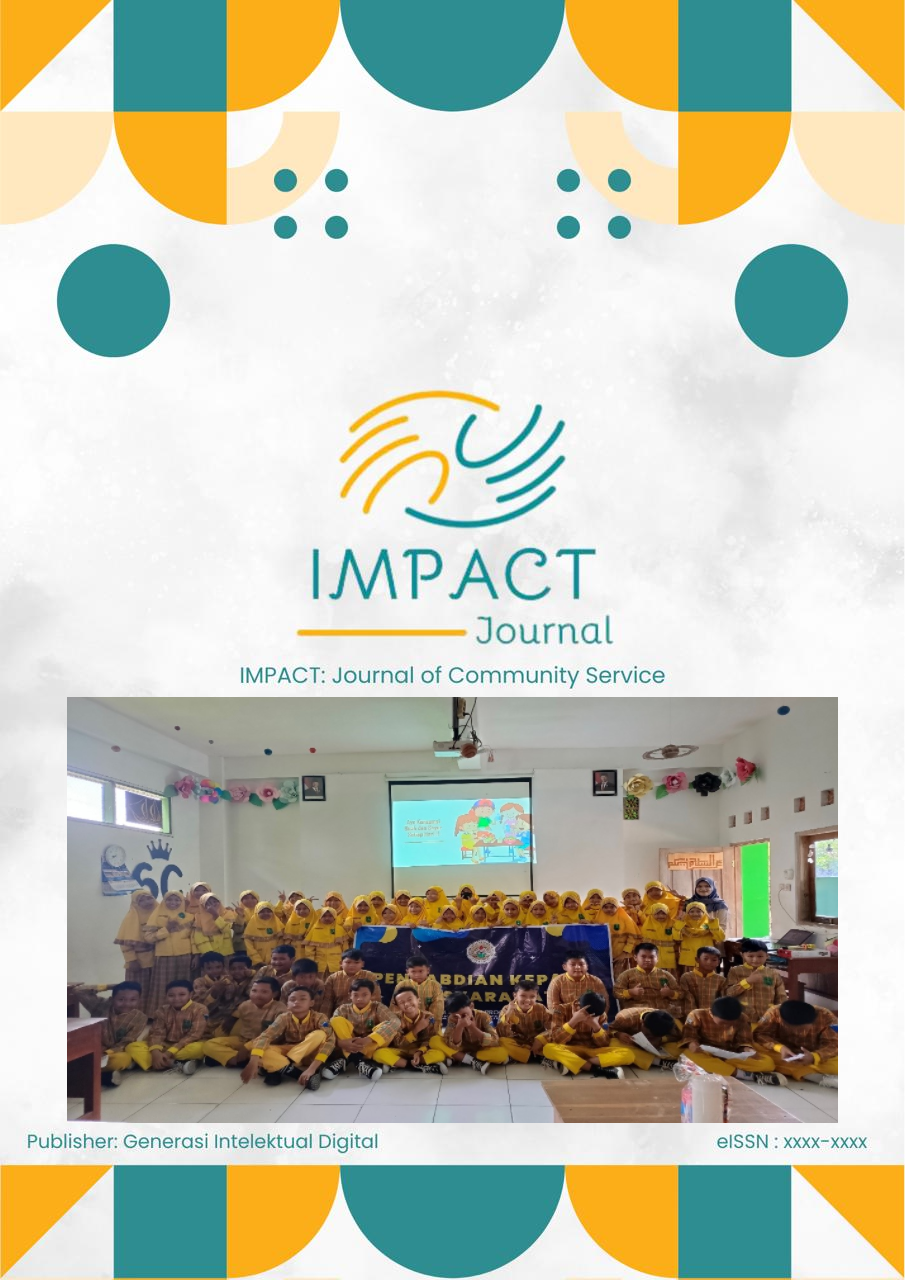
Learning prayer procedures to young children requires instructional media that can present movement sequences clearly and attractively. This community service project developed an Android-based markerless Augmented Reality (AR) application, named AR Shalat, to visualize the movements of the five daily prayers as three-dimensional animations without printed markers. The application was developed using the Waterfall model through requirements analysis, system design, implementation, and functional testing. Markerless plane detection was implemented using ARCore in Unity, while the three-dimensional character and movement animations were created in Blender. Functional black-box testing showed that the main application functions, including camera initialization, plane detection, 3D character placement, animation playback, and menu navigation, operated as intended. Under the tested conditions, plane detection was completed in less than 3 seconds on textured surfaces with adequate lighting. The application was also directly tried by young children as the intended users to observe its ease of use and their responses to the three-dimensional visualizations. However, learning effectiveness was not quantitatively evaluated. These results indicate that the application is technically feasible as an interactive visual aid for introducing prayer procedures to young children. Further evaluation using standardized usability and learning-outcome instruments is required before conclusions regarding educational effectiveness can be made.
References
Adlani, F., Ikhwan, A., & Putri, R. A. (2023). Aplikasi media pembelajaran praktik sholat Idul Fitri menggunakan augmented reality berbasis Android. Bulletin of Computer Science Research, 4(1), 129–141. https://doi.org/10.47065/bulletincsr.v4i1.322
Amelia, R., Purwati, & Rosnina. (2024). Penerapan teknologi interaktif dalam mengajarkan tata cara sholat di RA Binuang Padang. EduSpirit: Jurnal Pendidikan Kolaboratif, 1(1), 550–555.
Atikah, C., Rusdiyani, I., & Ridela, R. (2023). Pengembangan media pembelajaran berbasis augmented reality pada tema binatang purba untuk meningkatkan kemampuan kognitif anak usia dini kelompok B (5–6) tahun di TK Tunas Insan Kamil Kota Serang. JEA (Jurnal Edukasi AUD), 9(2), 89–101. https://doi.org/10.18592/jea.v9i2.9326
Darmanto, A., Pradhana, F. R., Muriyatmoko, D., Putra, O. V., & Effendi, L. (2021). Implementation of augmented reality procedures for prayer using marker-based tracking method. Procedia of Engineering and Life Science, 2. https://doi.org/10.21070/pels.v2i0.1169
Gumelar, T., Sujjada, A., & Kharisma, I. L. (2025). Pengembangan media pembelajaran interaktif gerakan shalat berbasis AR (Studi kasus: Madrasah Diniyah Al-Barokah). JTIM: Jurnal Teknologi Informasi dan Multimedia, 7(3), 519–537. https://doi.org/10.35746/jtim.v7i3.779
Hayati, L. N., Manga, A. R., & Munawir, A. (2025). Implementasi augmented reality 3D animasi tata cara gerakan shalat berdasarkan empat mazhab menggunakan metode marker-based tracking. Buletin Sistem Informasi dan Teknologi Islam, 5(4), 353–362. https://doi.org/10.33096/busiti.v5i4.1923
Irawati, I., Hayati, L. N., & Alfath, M. N. (2023). Aplikasi augmented reality berbasis plane detection untuk visualisasi objek furniture ruangan. JIKO (Jurnal Informatika dan Komputer), 7(2), 244–250. https://doi.org/10.26798/jiko.v7i2.801
Kaseh, & Nasution, M. (2025). Pemanfaatan media augmented reality (AR) untuk meningkatkan pemahaman materi salat fardu pada siswa kelas V di SD Negeri 001 Bagan Batu Kota. Jurnal Pendidikan Kritis dan Kolaboratif, 1(2), 257–261.
Koumpouros, Y. (2024). Revealing the true potential and prospects of augmented reality in education. Smart Learning Environments, 11(1), 2. https://doi.org/10.1186/s40561-023-00288-0
Lai, J. W., & Cheong, K. H. (2022). Educational opportunities and challenges in augmented reality: Featuring implementations in physics education. IEEE Access, 10, 43143–43158. https://doi.org/10.1109/ACCESS.2022.3166478
Lubis, A. M., Khairani, S., & Rismayanti. (2024). Aplikasi anaglyph 3D tata cara sholat dan doa berbasis light virtual reality. Jurnal Ilmu Komputer dan Sistem Informasi, 3(2), 162–176. https://doi.org/10.70340/jirsi.v3i2.121
Madani, R., Jumadi, & Satrio, A. (2025). Penggunaan media pembelajaran berbasis augmented reality (AR) untuk meningkatkan minat belajar siswa kelas X SMKN 4 Banjarmasin. J-INSTECH: Journal of Instructional Technology, 6(1), 58–64. https://doi.org/10.20527/j-instech.v6i1.15212
Mahendra, D., Subroto, D. E., Barokah, B., Mudoifah, E., & Mudafiah, D. (2025). Penerapan augmented reality untuk meningkatkan motivasi belajar siswa. Jurnal Padamu Negeri, 2(2), 50–59. https://doi.org/10.69714/958k3814
Putra, K. I., Dawa, P. J. L., Burgos, Y. D., & Maulana, F. I. (2023). Implementation of augmented reality in study for human anatomy. Procedia Computer Science, 227, 709–717. https://doi.org/10.1016/j.procs.2023.10.575
Putri, D. F., & Baharun, H. (2023). The implementation of augmented reality in science education in secondary schools. International Journal of Instructional Technology, 2(1), 34–45. https://doi.org/10.33650/ijit.v2i1.9325
Rizkaini, D. A., Darmawati, Akib D, M., Jufri, M., & Saleh, M. (2025). Penggunaan media pembelajaran augmented reality untuk meningkatkan pemahaman materi salat terhadap hasil belajar peserta didik di UPTD SMPN 8 Parepare. Iqra: Jurnal Ilmu Kependidikan dan Keislaman, 20(1), 116–126. https://doi.org/10.56338/iqra.v20i1.6685
Romisa, F., Setiawan, Q. T., & Hidayat, M. K. (2023). Pengembangan media augmented reality anatomi tubuh manusia berbasis Android menggunakan metode Waterfall. Informatika Mulawarman: Jurnal Ilmiah Ilmu Komputer, 18(2), 109. https://doi.org/10.30872/jim.v18i2.17776
Ruzakki, H., Nashrullah, N., Junaedi, D., Khoiriyah, S., & Asror, M. (2024). Trend pemanfaatan teknologi augmented reality dan virtual reality dalam pembelajaran pendidikan agama Islam di Indonesia. Edukasi Islami: Jurnal Pendidikan Islam, 13(1). https://doi.org/10.30868/ei.v13i01.4888
Saravanos, A., & Curinga, M. X. (2023). Simulating the software development lifecycle: The Waterfall model. Applied System Innovation, 6(6), 108. https://doi.org/10.3390/asi6060108
Saputra, H. N., Fajriani, A., & Farni, W. O. (2024). Development of augmented reality as a learning media introduction of early childhood prayer guidelines. Proceeding of International Conference on Educational Governance, Policy, and Leadership (ICEGPL), 1(1), 12–30.
Siregar, S. (2025). Augmented reality as a learning media for Islamic education to improve students’ understanding of prayer procedures at SD Negeri 1205 Silenjeng. Journal of Media and Learning Technology, 1(1), 59–72. https://doi.org/10.62945/jmlt.v1i1.31
Uriawan, W., Zahran, M. A. H., Deswita, I. A., Taqwim, M. A., Ahmadi, I. M., & Pratama, M. Y. (2025). Implementation of augmented reality as an educational tool for practice in early childhood. arXiv. https://doi.org/10.48550/arXiv.2512.17354
Downloads
Published
How to Cite
Issue
Section
Citation Check
License
Copyright (c) 2026 Sidik Abdul Zabar Jabar

This work is licensed under a Creative Commons Attribution-ShareAlike 4.0 International License.


