
Pendampingan Psikososial Anak Korban Banjir dengan Trauma Healing dan Dukungan Kebutuhan Dasar di Gampong Tanjung Punti
DOI:
https://doi.org/10.60005/impact.v2i2.165Keywords:
psychosocial support, childern, flood disaster, trauma healing, basic needs supportAbstract
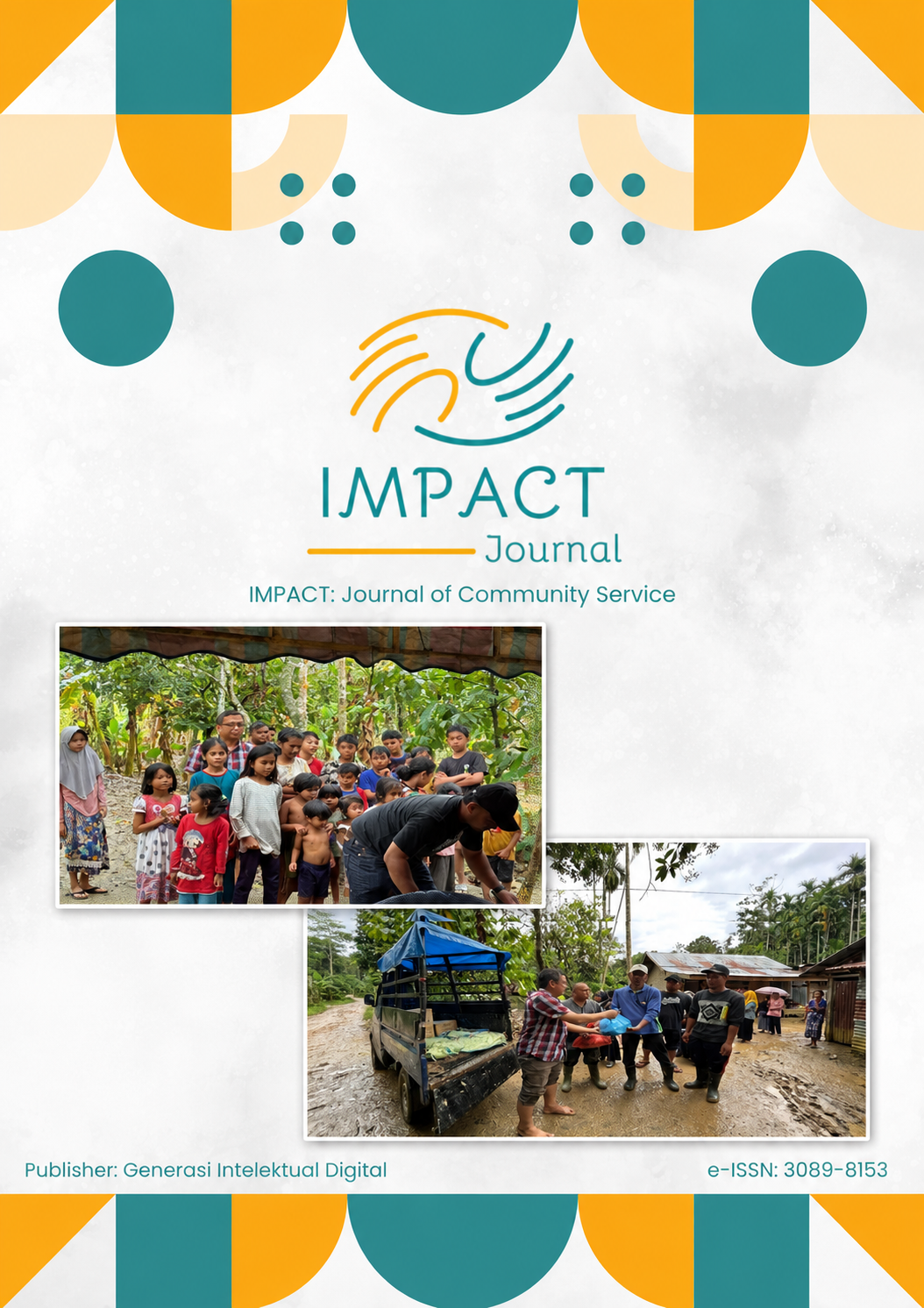
Floods that occurred in Gampong Tanjung Punti at the end of 2025 were associated with changes in the psychosocial conditions of children as a vulnerable group. Initial observations revealed that some children appeared anxious, less socially interactive, and still displayed fear-related expressions when recalling the flood event. This situation served as the basis for implementing a community service program integrating trauma healing, basic needs fulfillment, and spiritual support. The program aimed to support psychosocial assistance for flood-affected children through a participatory and child-friendly approach involving 35 children aged 5–12 years, village officials, and local community members. Activities included the distribution of basic supplies and clothing, provision of Qur’an copies, and trauma healing sessions through educational games, drawing, storytelling, and simple relaxation exercises. The results of the activities indicated increased children’s participation, improved emotional expression, and a growing sense of safety during the sessions. In addition, basic needs support and spiritual assistance were perceived to help reduce community burdens in the early post-disaster phase. The holistic approach integrating psychosocial support, basic needs fulfillment, and spiritual dimensions indicates potential support for early recovery processes among flood-affected children and communities.
References
Alfonso, M. R. A. (2018). Bridging healing and learning through the expressive arts to transform classrooms into healing spaces. Journal of Applied Arts & Health, 9(2), 185–202. https://doi.org/10.1386/jaah.9.2.185_1
Arianto, D. E., & Nawiyanto, S. (1988). Banjir Bengawan Solo dan pengaruhnya bagi kehidupan masyarakat di Kabupaten Bojonegoro tahun 2007–2008. Pemerintah Kabupaten Daerah Tingkat II Bojonegoro.
Apel, D., & Coenen, M. (2021). Mental health and health-related quality of life in victims of the 2013 flood disaster in Germany: A longitudinal study of health-related flood consequences and evaluation of institutionalized low-threshold psycho-social support. International Journal of Disaster Risk Reduction, 58, 102179. https://doi.org/10.1016/j.ijdrr.2021.102179
Aznar-Crespo, P., Aledo, A., Melgarejo-Moreno, J., & Vallejos-Romero, A. (2021). Adapting social impact assessment to flood risk management. Sustainability, 13(6), 3410. https://doi.org/10.3390/su13063410
Badan Nasional Penanggulangan Bencana. (2025). Perkembangan situasi dan penanganan bencana di tanah air per 25 November 2025. https://www.bnpb.go.id/berita/perkembangan-situasi-dan-penanganan-bencana-di-tanah-air-25-november-2025
Beaulac, L., Langlois, B., Berry, K., & Naumova, E. (2022). Natural disaster and migration trends in flood prone agricultural areas of Indonesia. Current Developments in Nutrition, 6, 72. https://doi.org/10.1093/cdn/nzac050.002
Birkhead, G. S., & Vermeulen, K. (2018). Sustainability of psychological first aid training for the disaster response workforce. American Journal of Public Health, 108(S5), S381–S382. https://doi.org/10.2105/AJPH.2018.304643
Chandra, Y. A., KawamurA, Y., Paudel, S., & Nishigawa, M. (2020). Value of mutual assistance for disaster risk reduction in Japan, Indonesia, and Nepal: A preliminary study. Health Emergency and Disaster Nursing, 7(1), 9-16. https://doi.org/10.24298/hedn.2018-0010
Cohen, E., & Gadassi, R. (2018). The function of play for coping and therapy with children exposed to disasters and political violence. Current Psychiatry Reports, 20, 31. https://doi.org/10.1007/s11920-018-0895-x
Dhawale, R., Schuster-Wallace, C. J., & Pietroniro, A. (2024). Assessing the multidimensional nature of flood and drought vulnerability index: A systematic review of literature. International Journal of Disaster Risk Reduction, 112, 104764. https://doi.org/10.1016/j.ijdrr.2024.104764
Epstein, K., DiCarlo, J., Marsh, R., Adhikari, B., Paudel, D., Ray, I., & Måren, I. E. (2018). Recovery and adaptation after the 2015 Nepal earthquakes. Ecology and Society, 23(1). https://doi.org/10.5751/ES-09909-230129
Gati, N. W., Pujiyanto, J. S., & Arifin, M. Z. (2024). Pemberdayaan Guru TK Aisyiyah Surakarta dalam Pendampingan Psikologis Paska Bencana. GEMASSIKA: Jurnal Pengabdian Kepada Masyarakat, 8(2), 106-111. https://doi.org/10.30787/gemassika.v8i2.1580
Heath, M. A., & Cutrer-Párraga, E. A. (2020). Healing after traumatic events: Aligning interventions with cultural background and religious and spiritual beliefs. Psychology in the Schools, 57(5), 718–734. https://doi.org/10.1002/pits.22358
Hirani, S. A. A., & Richter, S. (2019). Maternal and child health during forced displacement. Journal of Nursing Scholarship, 51(3), 252–261. https://doi.org/10.1111/jnu.12460
Im, H., Rodriguez, C., & Grumbine, J. M. (2021). A multitier model of refugee mental health and psychosocial support in resettlement: Toward trauma-informed and culture-informed systems of care. Psychological Services, 18(3), 345. https://doi.org/10.1037/ser0000412
Kendra, J., Clay, L., Gill, K., Trivedi, J., Marlowe, V., Aguirre, B., & Links, J. (2021). Community resilience: Toward a framework for an integrated, interdisciplinary model of disaster. Natural Hazards Review, 22(4), 04021049. https://doi.org/10.1061/(ASCE)NH.1527-6996.0000495
Kiran, P. S., Mohan, B., Abhijith, V., Abraham, A., Anoop, G., Dinesh, R. S., & Jaisoorya, T. S. (2021). Framework for strengthening primary health care and community networks to mitigate the long-term psychosocial impact of floods in Kerala. International Journal of Disaster Risk Reduction, 52, 101947. https://doi.org/10.1016/j.ijdrr.2020.101947
Kuriansky, J. (2019). A model psychosocial support training and workshop during a medical mission for Syrian refugee children in Jordan: Techniques, lessons learned and recommendations. Journal of Infant, Child, and Adolescent Psychotherapy, 18(4), 352–366. https://doi.org/10.1080/15289168.2019.1690925
Lai, B. S., La Greca, A. M., Colgan, C. A., Herge, W., Chan, S., Medzhitova, J., & Auslander, B. (2020). Sleep problems and posttraumatic stress: Children exposed to a natural disaster. Journal of Pediatric Psychology, 45(9), 1016–1026. https://doi.org/10.1093/jpepsy/jsaa061
Mahamid, F. A., & Bdier, D. (2021). The association between positive religious coping, perceived stress, and depressive symptoms during the spread of coronavirus (COVID-19) among a sample of adults in Palestine: A cross sectional study. Journal of Religion and Health, 60, 34–49. https://doi.org/10.1007/s10943-020-01121-5
Mayer, B. (2019). A review of the literature on community resilience and disaster recovery. Current Environmental Health Reports, 6, 167–173. https://doi.org/10.1007/s40572-019-00239-3
Miller, K. E., & Rasmussen, A. (2024). War exposure, daily stressors, and mental health 15 years on: Implications of an ecological framework for addressing the mental health of conflict-affected populations. Epidemiology and Psychiatric Sciences, 33, e78. https://doi.org/10.1017/S2045796024000830
North, C. S., Mendoza, S., Simic, Z., & Pfefferbaum, B. (2018). Parent-reported behavioral and emotional responses of children to disaster and parental psychopathology. Journal of Loss and Trauma, 23(4), 303–316. https://doi.org/10.1080/15325024.2018.1443710
Rubens, S. L., Felix, E. D., & Hambrick, E. P. (2018). A meta-analysis of the impact of natural disasters on internalizing and externalizing problems in youth. Journal of Traumatic Stress, 31(3), 332–341. https://doi.org/10.1002/jts.22292
Rustinsyah, R., Prasetyo, R. A., & Adib, M. (2021). Social capital for flood disaster management: Case study of flooding in a village of Bengawan Solo Riverbank, Tuban, East Java Province. International Journal of Disaster Risk Reduction, 52, 101963. https://doi.org/10.1016/j.ijdrr.2020.101963
Santos, J., Yip, C., Thekdi, S., & Pagsuyoin, S. (2020). Workforce/population, economy, infrastructure, geography, hierarchy, and time (WEIGHT): Reflections on the plural dimensions of disaster resilience. Risk Analysis, 40(1), 43–67. https://doi.org/10.1111/risa.13186
Sokang, Y. A., Omega, P. D., Novianty, A., Garey, E., Dawan, A., Hutapea, R. D., & Siantoro, A. (2024). Lesson learned from post-disaster psychosocial support for children in Palu, Central Sulawesi—Indonesia. Journal of Disaster Research, 19(4), 678–690. https://doi.org/10.20965/jdr.2024.p0678
Somasundaram, D. (2014). Addressing collective trauma: Conceptualisations and interventions. Intervention Journal of Mental Health and Psychosocial Support in Conflict Affected Areas, 12(4), 43–60. https://psycnet.apa.org/doi/10.1097/WTF.0000000000000068
Taufik, T., & Ibrahim, R. (2020). Making sense of disaster: Affinity to God as a coping strategy of Muslim refugees in Central Sulawesi. Journal of Loss and Trauma, 25(1), 61–73. https://doi.org/10.1080/15325024.2019.1655256
Topal, S., Çaka, S. Y., Uysal, G., et al. (2025). The effect of therapeutic play-based intervention programme applied to earthquake victim preschool children on psychosocial well-being: A randomised controlled trial. BMC Psychology, 13, 981. https://doi.org/10.1186/s40359-025-03317-4
Downloads
Published
How to Cite
Issue
Section
Citation Check
License
Copyright (c) 2026 Arief Rahman

This work is licensed under a Creative Commons Attribution-ShareAlike 4.0 International License.


