
KKN Sisdamas Siklus IV: Pelaksanaan, Monitoring, dan Evaluasi Program di Desa Pakuhaji, Kecamatan Cisalak, Kabupaten Subang
DOI:
https://doi.org/10.60005/impact.v2i1.158Keywords:
Sisdamas community service, community empowerment, Participatory Action Research, public health, waste managementAbstract
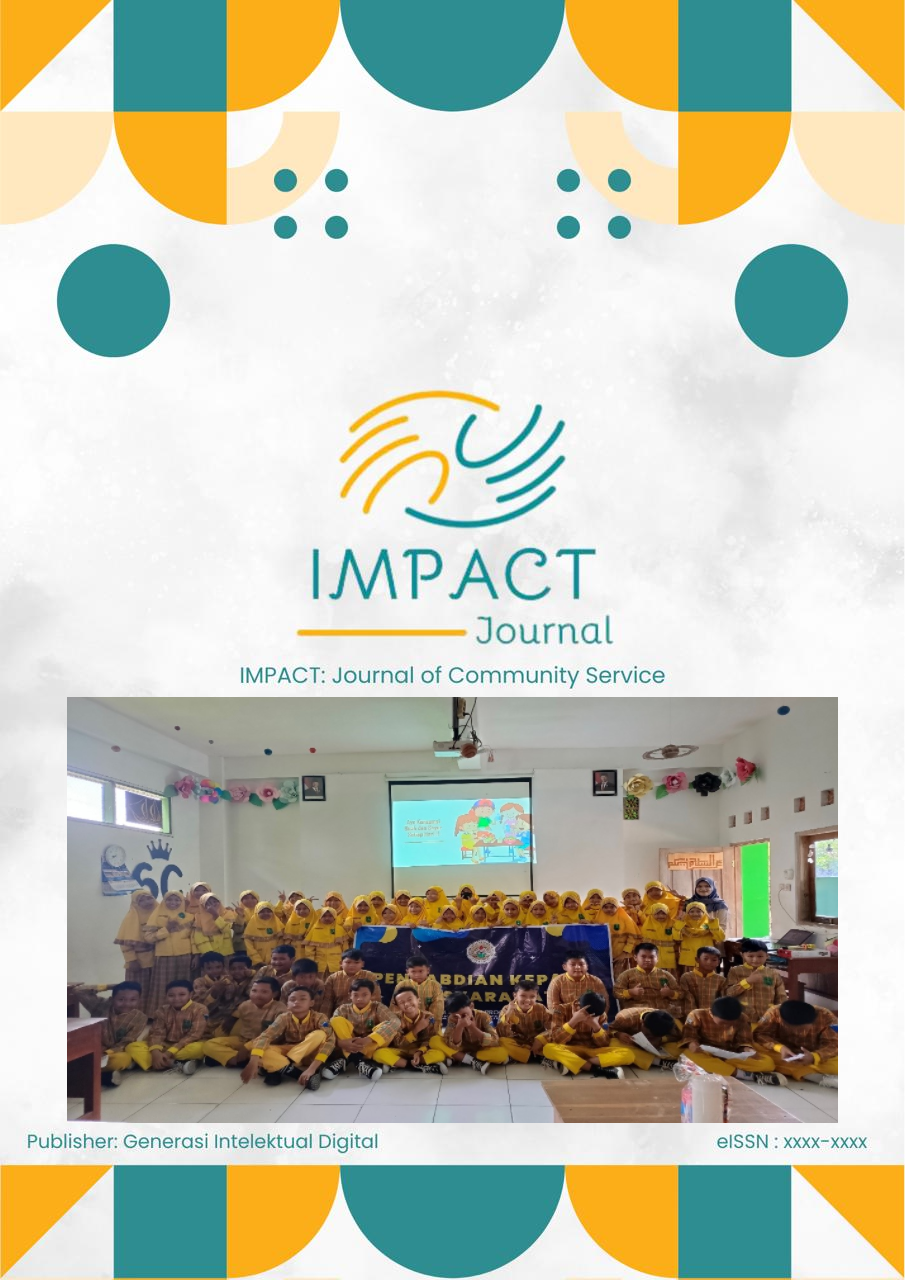
he fourth cycle of the Sisdamas Community Service Program in RW 02, Pakuhaji Village, was implemented in response to limited baseline health data, excessive gadget use among children, suboptimal plastic-bottle sorting, and the need to strengthen community participation. A 26-day Participatory Action Research (PAR) approach involved KKN Group 442 students, neighborhood leaders, youth groups, parents, children, and residents of RT 05–RT 08. Evaluation data were obtained from observations, attendance records, activity documentation, health-screening records, and participants’ verbal feedback. The priority activities comprised blood group and blood pressure screening, the 80th Indonesian Independence Day commemoration, traditional children’s games, and the Bottle House program. All activities were implemented as scheduled and produced immediate outputs, including health-screening records, social and cultural activities, screen-free play opportunities, and a facility for collecting plastic bottles. Because no structured pre–post assessment was conducted, the findings represent initial implementation and participation outcomes rather than evidence of behavioral change or improved quality of life. Follow-up monitoring with quantitative indicators is required to assess program effectiveness and sustainability.
References
Adhayati, B., Prameswari, Y. N., Hermawati, L., Wulansari, E. R., Zulfa, H. A., & Putri, N. R. (2025). Skrining tekanan darah sebagai langkah preventif komplikasi hipertensi pada masyarakat desa. PengabdianMu: Jurnal Ilmiah Pengabdian kepada Masyarakat, 10(12), 2662–2669. https://doi.org/10.33084/pengabdianmu.v10i12.10337
Baum, F., MacDougall, C., & Smith, D. (2006). Participatory action research. Journal of Epidemiology and Community Health, 60(10), 854–857. https://doi.org/10.1136/jech.2004.028662
Cyril, S., Smith, B. J., Possamai-Inesedy, A., & Renzaho, A. M. N. (2015). Exploring the role of community engagement in improving the health of disadvantaged populations: A systematic review. Global Health Action, 8, 29842. https://doi.org/10.3402/gha.v8.29842
Ferguson et al. (2025). Electronic screen use and children’s socioemotional problems: A systematic review and meta-analysis of longitudinal studies. Psychological Bulletin, 151(5), 513–543. https://doi.org/10.1037/bul0000468
Geissdoerfer, M., Savaget, P., Bocken, N. M. P., & Hultink, E. J. (2020). The circular economy—A new sustainability paradigm. Journal of Cleaner Production, 143, 757–768. https://doi.org/10.1016/j.jclepro.2016.12.048
Hasby, R. M., Hidayat, A., Makhroji, M., Febsi, Y., Syarifah, I. F., Fatimah, A. N., & Setiadi, A. (2025). Cek Kesehatan dan Pelatihan Pembuatan Obat Tradisional untuk Hipertensi di Desa Ramea Kabupaten Pandeglang. Martabe: Jurnal Pengabdian Kepada Masyarakat, 8(2), 896-902.
Kaza, S., Yao, L., Bhada-Tata, P., & Van Woerden, F. (2022). What a Waste 2.0: A Global Snapshot of Solid Waste Management. World Bank Publications.
Kirchherr, J., Reike, D., & Hekkert, M. (2023). Conceptualizing the circular economy: An analysis of 114 definitions. Resources, Conservation and Recycling, 186, 106554. https://doi.org/10.1016/j.resconrec.2017.09.005
Khodari, R., & Nurhidayah, S. (2025). Pemberdayaan kearifan lokal: Permainan tradisional sebagai upaya pelestarian budaya nusantara serta sarana interaksi sosial masyarakat. Bima Abdi: Jurnal Pengabdian Masyarakat, 5(2), 494-501. https://doi.org/10.53299/bajpm.v5i2.2029
Kristina, M., Usmanto, B., Kasmi, K., Angelia, F., & Habibah, H. (2025). Edukasi pengelolaan sampah melalui bank sampah dan tempat pengelolaan sampah Reduce, Reuse, Recycle (TPS3R) di Jejama Secancanan Kabupaten Pringsewu. NEAR: Jurnal Pengabdian Kepada Masyarakat, 4(2), 292-301. https://doi.org.10.32877/nr.v4i2.2877
Oktora, M. Z., Anggraini, D., Haiga, Y., Liana, N., Nurwiyeni, Putriyuni, A., Aliefia, D. (2023). Skrining tekanan darah, gula darah, dan status gizi sebagai upaya pencegahan penyakit kronis di masyarakat. Jurnal Pengabdian Masyarakat Kesehatan, 5(2), 101–108.
O’Mara-Eves, A., Brunton, G., McDaid, D., Oliver, S., Kavanagh, J., Jamal, F., et al. (2015). The effectiveness of community engagement in public health interventions for disadvantaged groups: A meta-analysis. BMC Public Health, 15, 129. https://doi.org/10.1186/s12889-015-1352-y
Ren, W. (2023). The influence of screen media usage on child social development: A systematic review. Journal of Education, Humanities and Social Sciences, 8. https://doi.org/10.54097/ehss.v8i.4655
Rini, N. M., Pratiwi, I. A., & Ahsin, M. N. (2021). Dampak Penggunaan Gadget Terhadap Perilaku Sosial Anak Usia Sekolah Dasar. Jurnal Educatio, 7(3), 1236-1241. https://doi.org.10.31949/educatio.v7i3.1379
Rousta, K., Zisen, L., & Hellwig, C. (2020). Household waste sorting participation in developing countries—A meta-analysis. Recycling, 5(1), 6. https://doi.org/10.3390/recycling5010006
Saputri, R. D., Prasetyo, A., & Wibowo, E. (2022). Program bank sampah dan dampaknya terhadap kesadaran lingkungan masyarakat. Jurnal Pengabdian kepada Masyarakat, 7(1), 55–63.
Sudaryanti, Prayitno, Arifiyanti, N., & Maharani, O. (2024). Pengembangan Kemampuan Motorik dan Sosial Emosional Anak Usia Dini Menggunakan Permainan Tradisional. Jurnal Pendidikan Anak,13(1), 2024, 114-125.
Yudhanto, W., Sihite, M., & Fahadha, R. U. (2025). Optimalisasi pemberdayaan masyarakat berbasis kesenian dan kearifan lokal sanggar seni Kelurahan Potrobangsan Magelang. Income: Indonesian Journal of Community Service and Engagement, 4(1), 22-33. https://doi.org/10.56855/income.v4i1.1366
Downloads
Published
How to Cite
Issue
Section
Citation Check
License
Copyright (c) 2026 Iwan Ridwan Yusup, Anindi Yuli Fauziah, Imam Muzakki Arifin, Rahmah Afifah Nurwahidah, Vera Jesslyn Setiawan

This work is licensed under a Creative Commons Attribution-ShareAlike 4.0 International License.


