
Implementation of Finite State Automata on e-Knows Telegram Chatbot
##plugins.themes.bootstrap3.article.sidebar##
##plugins.themes.bootstrap3.article.main##
Abstract
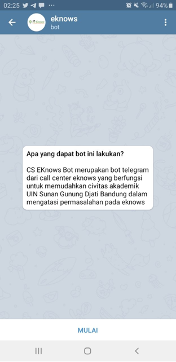
The State Islamic University of Sunan Gunung Djati Bandung has a bold learning system called e-Knows. So far, if the user has a school, he must contact the admin manually. The problems are diverse, and several issues can bring personal impact. Automata language theory is the basic logic for mapping the telegram e-Knows chatbot system. The mapping is done by dividing each system using finite state automata to facilitate the completion of the system.
##plugins.themes.bootstrap3.article.details##

This work is licensed under a Creative Commons Attribution-ShareAlike 4.0 International License.
Authors who publish articles in CoreID Journal agree to the following terms:
- Authors retain copyright of the article and grant the journal right of first publication with the work simultaneously licensed under a CC-BY-SA or The Creative Commons Attribution–ShareAlike License.
- Authors are able to enter into separate, additional contractual arrangements for the non-exclusive distribution of the journal's published version of the work (e.g., post it to an institutional repository or publish it in a book), with an acknowledgment of its initial publication in this journal.
- Authors are permitted and encouraged to post their work online (e.g., in institutional repositories or on their website) prior to and during the submission process, as it can lead to productive exchanges, as well as earlier and greater citation of published work (See The Effect of Open Access).
References
O. El-Said and H. Aziz, “Virtual Tours a Means to an End: An Analysis of Virtual Tours’ Role in Tourism Recovery Post COVID-19,” J. Travel Res., vol. 61, no. 3, pp. 528–548, Mar. 2022.
D. S. A. Maylawati et al., “Chatbot for Virtual Travel Assistant with Random Forest and Rapid Automatic Keyword Extraction,” 7th Int. Conf. Comput. Eng. Des. ICCED 2021, 2021.
F. R. Daud, V. Tulenan, and X. B. N. Najoan, “Virtual Tour Panorama 360 Derajat Kampus Universitas Sam Ratulangi Manado,” J. Tek. Inform., vol. 8, no. 1, Aug. 2016.
T. Yang, I. K. W. Lai, Z. Bin Fan, and Q. M. Mo, “The impact of a 360° virtual tour on the reduction of psychological stress caused by COVID-19,” Technol. Soc., vol. 64, p. 101514, Feb. 2021.
M. Godovykh, C. Baker, and A. Fyall, “VR in Tourism: A New Call for Virtual Tourism Experience amid and after the COVID-19 Pandemic,” Tour. Hosp. 2022, Vol. 3, Pages 265-275, vol. 3, no. 1, pp. 265–275, Feb. 2022.
A. Brown and T. Green, “Virtual Reality: Low-Cost Tools and Resources for the Classroom,” TechTrends, vol. 60, no. 5, pp. 517–519, 2016.
D. Dio, N. Safriadi, and A. S. Sukamto, “Rancang Bangun Aplikasi Virtual Tour Lokasi Rekreasi dan Hiburan Keluarga di Pontianak,” JUSTIN (Jurnal Sist. dan Teknol. Informasi), vol. 7, no. 1, pp. 1–6, Jan. 2019.
T. Umar et al., “Pemanfaatan Virtual Tour Museum (VTM) dalam Pembelajaran Sejarah di Masa Pandemi Covid-19,” Pros. Semin. Nas. Pendidik. FKIP, vol. 3, no. 1, pp. 402–408, Nov. 2020.
A. P. Andriyandi, W. Darmalaksana, D. Sa’adillah Maylawati, F. S. Irwansyah, T. Mantoro, and M. A. Ramdhani, “Augmented reality using features accelerated segment test for learning tajweed,” TELKOMNIKA (Telecommunication Comput. Electron. Control., vol. 18, no. 1, pp. 208–216, Feb. 2020.
A. Amanta, “Telusuri dan Ketahui Virtual Tourism Lebih Dalam!,” https://www.smarteye.id/, 2021. [Online]. Available: https://www.smarteye.id/blog/apa-itu-virtual-tour/.
M. U. Kawulur, Y. D. Y. Rindengan, and X. B. N. Najoan, “Virtual Tour e-Tourism Objek Wisata Alam di Kabupaten Biak Numfor,” J. Tek. Inform., vol. 13, no. 3, Sep. 2018.
M. Aminudin and P. Prasetyawan, “Pengenalan Fasilitas Perguruan Tinggi Teknokrat Menggunakan Panorama 3600 Berbasis Android,” J. Teknoinfo, vol. 11, no. 1, pp. 14–18, Jan. 2017.
A. Z. Z. Falani, H. H. A. S. Ramadan, and E. S. Setiawan, “Implementasi Sistem Virtual Tour Berbasis E-Panorama untuk Pengenalan Kampus Universitas Narotama Surabaya,” Insa. Comtech Inf. Sci. Comput. Technol. J., vol. 1, no. 1, May 2016.
S. S. Kusuma and E. Herlina, “Visualisasi Green Campus Universitas Kuningan dalam Panorama Fotografi Panosphere,” J. Signal, vol. 9, no. 2, pp. 159–168, Sep. 2021.
A. Novianto Suwardi, I. M. Saryan, and C. I. P. Nindia, “Pesona Jember dalam Fotografi Landscape,” Retin. J. Fotogr., vol. 1, no. 2, Sep. 2021.
N. I. Sholihin and D. Lelono, “Otomasi Trigger dengan Penentuan Sudut dalam Foto Panorama Berbasis Arduino Uno,” IJEIS, vol. 5, no. 2, pp. 123–132, 2015.
“Trip in Indonesian,” http://www.bambootrip.ru/. [Online]. Available: http://www.bambootrip.ru/countries/excursions/document65001_info.htm.
H. R. Raehana, “360° PHOTO TECHNIQUES AND VIRTUAL REALITY IN CINEMATOGRAPHY,” Arty J. Seni Rupa, vol. 11, no. 2, pp. 56–63, Jul. 2022.
“Monumen Nasional,” https://cloudflare1.360gigapixels.com/. [Online]. Available: https://cloudflare1.360gigapixels.com/pano/min-heo/00094904_DSC_1227_Panorama_no_FINAL.jpg/equirect_crop_3_1/6.jpg. [Accessed: 13-Mar-2022].

Syahrizal Dwi Putra, “Media Pembelajaran dan Sosialisasi Penyakit TBC,” JISAMAR J. Inf. Syst. Applied, Manag. Account. Res., vol. 2, no. 2, May 2018.
F. N. Kumala, A. Ghufron, P. P. Astuti, M. Crismonika, M. N. Hudha, and C. I. R. Nita, “MDLC model for developing multimedia e-learning on energy concept for primary school students,” J. Phys. Conf. Ser., vol. 1869, no. 1, p. 012068, Apr. 2021.
R. Arpiansah, Y. Fernando, and J. Fakhrurozi, “Game Edukasi VR Pengenalan dan Pencegahan Virus Covid-19 Menggunakan Metode MDLC untuk Anak Usia Dini,” J. Teknol. dan Sist. Inf., vol. 2, no. 2, pp. 88–93, Jul. 2021.
N. A. Istiqomah, K. Imayah, N. Saidah, and M. A. Yaqin, “Pengembangan Arsitektur Data Sistem Informasi Pondok Pesantren,” Jurasik (Jurnal Ris. Sist. Inf. dan Tek. Inform., vol. 5, no. 1, pp. 27–35, Mar. 2020.
M. F. Febriansyah and Y. Sumaryana, “Pengembangan Aplikasi Media Pembelajaran Sekolah Dasar Menggunakan Metode Multimedia Development Life Cycle (MDLC),” Informatics Digit. Expert, vol. 3, no. 2, pp. 61–68, Nov. 2021.
R. I. Borman and Y. Purwanto, “Impelementasi Multimedia Development Life Cycle pada Pengembangan Game Edukasi Pengenalan Bahaya Sampah pada Anak,” JEPIN (Jurnal Edukasi dan Penelit. Inform., vol. 5, no. 2, pp. 119–124, Aug. 2019.