
Academic Data Quality Measurement in SALAM Application Using Six Sigma Method
##plugins.themes.bootstrap3.article.sidebar##
##plugins.themes.bootstrap3.article.main##
Abstract
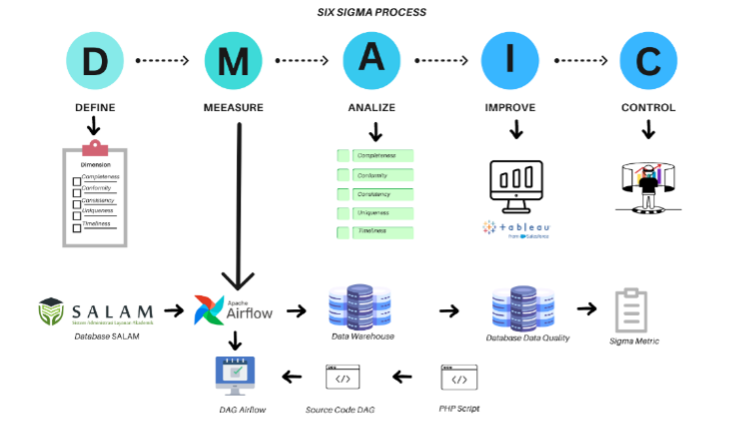
Data quality plays a critical role in ensuring the reliability and usefulness of information for decision making in higher education institutions. However, academic data within the SALAM application at UIN Sunan Gunung Djati Bandung has not previously undergone a systematic quality assessment, leading to uncertainty in several managerial and academic decisions. This study aims to evaluate the quality of academic data in the SALAM application using the Six Sigma method with the DMAIC (Define–Measure–Analyze–Improve–Control) framework. Five data quality dimensions completeness, consistency, conformity, uniqueness, and timeliness are employed to measure and analyze data quality performance. The measurement process begins with data definition and extraction, followed by quantitative analysis using sigma metrics. The results indicate that the overall quality of academic data is at a moderate level, with an average sigma score of approximately 3, primarily influenced by incomplete and inconsistent data. In contrast, the timeliness dimension demonstrates excellent performance, achieving a sigma metric of 6 due to the long-term availability of data over more than ten years. This study contributes by providing an empirical, data-driven evaluation of academic data quality and offers practical insights for implementing continuous monitoring and improvement strategies to enhance data reliability and support more effective decision making in higher education institutions.
##plugins.themes.bootstrap3.article.details##

This work is licensed under a Creative Commons Attribution-ShareAlike 4.0 International License.
Authors who publish articles in CoreID Journal agree to the following terms:
- Authors retain copyright of the article and grant the journal right of first publication with the work simultaneously licensed under a CC-BY-SA or The Creative Commons Attribution–ShareAlike License.
- Authors are able to enter into separate, additional contractual arrangements for the non-exclusive distribution of the journal's published version of the work (e.g., post it to an institutional repository or publish it in a book), with an acknowledgment of its initial publication in this journal.
- Authors are permitted and encouraged to post their work online (e.g., in institutional repositories or on their website) prior to and during the submission process, as it can lead to productive exchanges, as well as earlier and greater citation of published work (See The Effect of Open Access).
References
I. Anas and A. Hidayat, “Implementasi Algoritma Vigeneere Cipher dan GOST dalam Keamanan Data,” Journal & Penelitian Teknik Informatika, vol. 2, no. 2, 2018.
Jr. , C. G. C. R. Kelly Rainer, Introduction to information systems. 2013.
D. Sawitri, “REVOLUSI INDUSTRI 4.0 : BIG DATA MENJAWAB TANTANGAN REVOLUSI INDUSTRI 4.0,” 2019.
B. , H. D. , K. M. , S. A. , & S. M. Heinrich, “Requirements for Data Quality Metrics,” Journal of Data and Information Quality, vol. 9, no. 2, pp. 1–32, 2018.
“Peluncuran Aplikasi New SALAM pada Rapat Koordinasi Bagian Akademik Tahun 2021 - UIN Sunan Gunung Djati Bandung.” Accessed: Jun. 16, 2023. [Online]. Available: https://uinsgd.ac.id/peluncuran-aplikasi-new-salam-pada-rapat-koordinasi-bagian-akademik-tahun-2021/
N. Makhoul, “Review of data quality indicators and metrics, and suggestions for indicators and metrics for structural health monitoring,” Dec. 01, 2022, Springer. doi: 10.1186/s43251-022-00068-9.
D. Gürdür, J. El-khoury, and M. Nyberg, “Methodology for linked enterprise data quality assessment through information visualizations,” J Ind Inf Integr, vol. 15, pp. 191–200, Sep. 2019, doi: 10.1016/j.jii.2018.11.002.
“Analisis Penerapan ISO 9001:2015 Industri Makanan: Sebuah Narrative Literature Review”, [Online]. Available: https://jisma.org
“ANALISIS MANAJEMEN MUTU TERPADU (TQM) DALAM PELAYANAN RUMAH SAKIT.”
B. Klefsjo, H. Ê. Kan Wiklund, and R. L. Edgeman, “SIX SIGMA SEEN AS A METHODOLOGY FOR TOTAL QUALITY MANAGEMENT.” [Online]. Available: http://www.emerald-library.com/ft
S. Koppel and S. Chang, “MDAIC – a Six Sigma implementation strategy in big data environments,” International Journal of Lean Six Sigma, vol. 12, no. 2, pp. 432–449, Mar. 2021, doi: 10.1108/IJLSS-12-2019-0123.
A. S. Patel and K. M. Patel, “Critical review of literature on Lean Six Sigma methodology,” 2020, Emerald Group Holdings Ltd. doi: 10.1108/IJLSS-04-2020-0043.
Y. Z. Mehrjerdi, “Six-Sigma: Methodology, tools and its future,” Assembly Automation, vol. 31, no. 1, pp. 79–88, 2011, doi: 10.1108/01445151111104209.
Y. Latief and dan Retyaning Puji Utami, “PENERAPAN PENDEKATAN METODE SIX SIGMA DALAM PENJAGAAN KUALITAS PADA PROYEK KONSTRUKSI,” 2009.
S. H. Cahyono, Y. G. Sucahyo, J. S. Raya, and J. Pusat, “Pengukuran Kualitas Data Menggunakan Framework Total Data Quality Management (TDQM): Studi Kasus Sistem Informasi Beasiswa Universitas Indonesia Data Quality Assessment Using the TDQM Framework: A Case Study of University of Indonesia (UI) Scholarship Information System,” Jurnal Ilmu Pengetahuan dan Teknologi Komunikasi, vol. 22, no. 2, pp. 193–206, doi: 10.33164/iptekkom.22.2.2020.193-206.
D. Nur Fauziah, D. Ayu Nur Wulandari, S. Informasi, K. Akuntansi, S. Nusa Mandiri Jakarta, and A. BSI Karawang, “PENGUKURAN KUALITAS LAYANAN BUKALAPAK.COM TERHADAP KEPUASAN KONSUMEN DENGAN METODE WEBQUAL 4.0,” 2021, [Online]. Available: http://www.nusamandiri.ac.id1,http://www.bsi.ac.id2
M. Panwar, “Application of Six-Sigma for Data Quality Improvement in an Insurance Company,” INTERNATIONAL JOURNAL OF SCIENTIFIC & TECHNOLOGY RESEARCH, vol. 4, no. 09, 2015, [Online]. Available: www.ijstr.org
J. De Mast and J. Lokkerbol, “An analysis of the Six Sigma DMAIC method from the perspective of problem solving,” Int J Prod Econ, vol. 139, no. 2, pp. 604–614, Oct. 2012, doi: 10.1016/j.ijpe.2012.05.035.
M. J. Jamshidi, M. Hosseinpour, H. Heshmati, and B. Fathi Zolmabadi, “Improving the Performance of Hospital Information Systems Using Six Sigma for Kermanshah Province Hospitals,” Journal of Clinical Research in Paramedical Sciences, vol. 10, no. 1, Mar. 2021, doi: 10.5812/jcrps.102448.
P. Kaushik and D. Khanduja, “Application of six sigma DMAIC methodology in thermal power plants: A case study,” Total Quality Management and Business Excellence, vol. 20, no. 2, pp. 197–207, 2009, doi: 10.1080/14783360802622995.
A. M. Ponsiglione et al., “A six sigma DMAIC methodology as a support tool for health technology assessment of two antibiotics,” Mathematical Biosciences and Engineering, vol. 18, no. 4, pp. 3469–3490, 2021, doi: 10.3934/MBE.2021174.
M. M. B. Tufail, A. Shamim, A. Ali, M. Ibrahim, D. Mehdi, and W. Nawaz, “DMAIC methodology for achieving public satisfaction with health departments in various districts of Punjab and optimizing CT scan patient load in urban city hospitals,” AIMS Public Health, vol. 9, no. 2, pp. 440–457, 2022, doi: 10.3934/publichealth.2022030.