
Sentiment Analysis and Twitter Social Media Visualization Regarding the Omnibus Law Draft
##plugins.themes.bootstrap3.article.sidebar##
##plugins.themes.bootstrap3.article.main##
Abstract
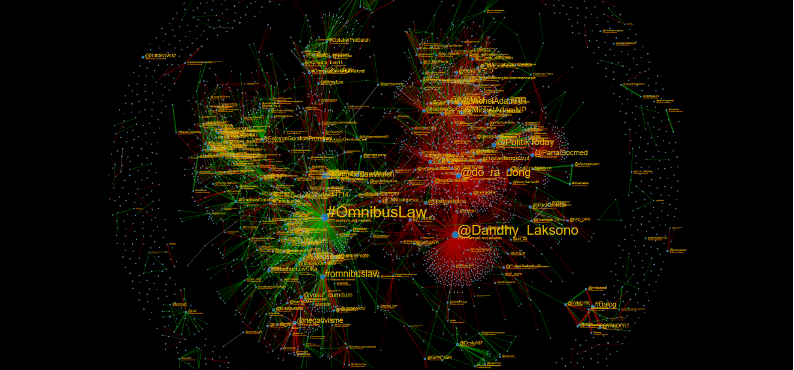
This study will classify Twitter users' positive and negative opinions about the omnibus method using a frequency-inverse document frequency algorithm and a multi-layer perceptron method. The sentiment analysis process involves several stages, including B. Collecting and preprocessing data, calculating term weights using inverse term frequencies and document frequencies, and classifying data using multi-layer perceptrons. Additionally, the study visually represents Twitter's sentiment analysis results on the omnibus method. These visualizations include word cloud, top accounts, tweet frequency, hashtags, and sentiment. Three scenarios were considered to perform the classification experiments. Scenario 1 used 700 training data, scenario 2 used 800, and Scenario 3 used 900 training data. The findings show that the Term Frequency Inverse Document Frequency algorithm and the multi-layer perceptron method are adequate for sentiment analysis, with Scenario 3 yielding the highest accuracy rate of 88%.
##plugins.themes.bootstrap3.article.details##

This work is licensed under a Creative Commons Attribution-ShareAlike 4.0 International License.
Authors who publish articles in CoreID Journal agree to the following terms:
- Authors retain copyright of the article and grant the journal right of first publication with the work simultaneously licensed under a CC-BY-SA or The Creative Commons Attribution–ShareAlike License.
- Authors are able to enter into separate, additional contractual arrangements for the non-exclusive distribution of the journal's published version of the work (e.g., post it to an institutional repository or publish it in a book), with an acknowledgment of its initial publication in this journal.
- Authors are permitted and encouraged to post their work online (e.g., in institutional repositories or on their website) prior to and during the submission process, as it can lead to productive exchanges, as well as earlier and greater citation of published work (See The Effect of Open Access).
References
H. K. Duan, M. A. Vasarhelyi, M. Codesso, and Z. Alzamil, “Enhancing the government accounting information systems using social media information: An application of text mining and machine learning,” Int. J. Account. Inf. Syst., vol. 48, p. 100600, Mar. 2023, doi: 10.1016/J.ACCINF.2022.100600.
S. Al-Fatih, “Harmonisasi Regulasi Hubungan Pusat & Daerah Melalui Omnibus Law (Harmonizing Regulation Of Central & Local Regulations Through The Omnibus Law),” SSRN Electron. J., Jul. 2020, doi: 10.2139/SSRN.3857493.
B. Pang and L. Lee, “Opinion mining and sentiment analysis,” 2008.
S. Bayrakdar, I. Yucedag, M. Simsek, and I. A. Dogru, “Semantic analysis on social networks: A survey,” Int. J. Commun. Syst., vol. 33, no. 11, p. e4424, Jul. 2020, doi: 10.1002/DAC.4424.
U. Can and B. Alatas, “A new direction in social network analysis: Online social network analysis problems and applications,” Phys. A Stat. Mech. its Appl., vol. 535, p. 122372, Dec. 2019, doi: 10.1016/J.PHYSA.2019.122372.
L. Hudders, S. De Jans, and M. De Veirman, “The commercialization of social media stars: a literature review and conceptual framework on the strategic use of social media influencers,” https://doi.org/10.1080/02650487.2020.1836925, vol. 40, no. 3, pp. 327–375, 2020, doi: 10.1080/02650487.2020.1836925.
T. Okumura and Y. Kanatani, “Health Crisis Management and Natural Language Processing,” J. Nat. Lang. Process., vol. 20, no. 3, pp. 513–524, 2013, doi: 10.5715/JNLP.20.513.
D. Khurana, A. Koli, K. Khatter, and S. Singh, “Natural language processing: state of the art, current trends and challenges,” Multimed. Tools Appl., vol. 82, no. 3, pp. 3713–3744, Jan. 2023, doi: 10.1007/S11042-022-13428-4/FIGURES/3.
F. Hemmatian and M. K. Sohrabi, “A survey on classification techniques for opinion mining and sentiment analysis,” Artif. Intell. Rev., vol. 52, no. 3, pp. 1495–1545, Oct. 2019, doi: 10.1007/S10462-017-9599-6/METRICS.
E. Dwianto and M. Sadikin, “Analisis Sentimen Transportasi Online pada Twitter Menggunakan Metode Klasifikasi Naïve Bayes dan Support Vector Machine,” Format J. Ilm. Tek. Inform., vol. 10, no. 1, pp. 94–100, Feb. 2021, doi: 10.22441/FORMAT.2021.V10.I1.009.
R. Ferdiana, F. Jatmiko, D. D. Purwanti, A. Sekar, T. Ayu, and W. F. Dicka, “Dataset Indonesia untuk Analisis Sentimen,” J. Nas. Tek. Elektro dan Teknol. Inf., vol. 8, no. 4, pp. 334–339, Nov. 2019, Accessed: May 20, 2023. [Online]. Available: https://jurnal.ugm.ac.id/v3/JNTETI/article/view/2558
B. Lu, M. Ott, C. Cardie, and B. Tsou, Multi aspect sentiment analysis with topic models, IEEE 11 th. 2011.
N. Thakur, “Twitter Big Data as a Resource for Exoskeleton Research: A Large-Scale Dataset of about 140,000 Tweets from 2017-2022 and 100 Research Questions,” Anal. 2022, Vol. 1, Pages 72-97, vol. 1, no. 2, pp. 72–97, Sep. 2022, doi: 10.3390/ANALYTICS1020007.
C. Udanor and C. C. Anyanwu, “Combating the challenges of social media hate speech in a polarized society: A Twitter ego lexalytics approach,” Data Technol. Appl., vol. 53, no. 4, pp. 501–527, Oct. 2019, doi: 10.1108/DTA-01-2019-0007/FULL/XML.
S. F. Rodiyansyah and E. Winarko, “Klasifikasi Posting Twitter Kemacetan Lalu Lintas Kota Bandung Menggunakan Naive Bayesian Classification,” IJCCS (Indonesian J. Comput. Cybern. Syst., vol. 6, no. 1, Jan. 2013, doi: 10.22146/ijccs.2144.
Z. Kalinić, V. Marinković, L. Kalinić, and F. Liébana-Cabanillas, “Neural network modeling of consumer satisfaction in mobile commerce: An empirical analysis,” Expert Syst. Appl., vol. 175, p. 114803, Aug. 2021, doi: 10.1016/J.ESWA.2021.114803.
A. H. S. Hamdany, R. R. O. Al-Nima, and L. H. Albak, “Translating cuneiform symbols using artificial neural network,” TELKOMNIKA (Telecommunication Comput. Electron. Control., vol. 19, no. 2, pp. 438–443, Apr. 2021, doi: 10.12928/TELKOMNIKA.V19I2.16134.
T. C. My, L. D. Khanh, and P. M. Thao, “An Artificial Neural Networks (ANN) Approach for 3 Degrees of Freedom Motion Controlling,” JOIV Int. J. Informatics Vis., vol. 7, no. 2, pp. 301–309, May 2023, doi: 10.30630/JOIV.7.2.1817.
M. S. Al-Batah, S. Mrayyen, and M. Alzaqebah, “Arabic Sentiment Classification using MLP Network Hybrid with Naive Bayes Algorithm,” J. Comput. Sci., vol. 14, no. 8, pp. 1104–1114, Aug. 2018, doi: 10.3844/JCSSP.2018.1104.1114.
R. Melita, V. Amrizal, H. B. Suseno, and T. Dirjam, “Penerapan Metode Term Frequency Inverse Document Frequency (TF-DF) dan Cosine Similarity pada Sistem Temu Kembali Informasi untuk Mengetahui Syarah Hadits Berbasis Web (Studi Kasus: Hadits Shahih Bukhari-Muslim),” J. Tek. Inform., vol. 11, no. 2, pp. 149–164, Nov. 2018, doi: 10.15408/JTI.V11I2.8623.
A. R. Atmadja and A. Purwarianti, “Comparison on the rule based method and statistical based method on emotion classification for Indonesian Twitter text,” in 2015 International Conference on Information Technology Systems and Innovation, ICITSI 2015 - Proceedings, 2016. doi: 10.1109/ICITSI.2015.7437692.
M. Sumathi and S. A. Parvin, “Nuances of data pre-processing and its impact on business,” Proc. - 5th Int. Conf. Intell. Comput. Control Syst. ICICCS 2021, pp. 1006–1012, May 2021, doi: 10.1109/ICICCS51141.2021.9432376.
M. Alsolamy, A. M. Alotaibi, A. Alabbas, M. Abdullah, M. Abdulaziz, and A. Alotaibi, “Topic based Sentiment Analysis for COVID-19 Tweets,” Artic. Int. J. Adv. Comput. Sci. Appl., vol. 12, no. 1, p. 2021, 2021, doi: 10.14569/IJACSA.2021.0120172.
A. K. Uysal and S. Gunal, “The impact of preprocessing on text classification,” Inf. Process. Manag., vol. 50, no. 1, pp. 104–112, Jan. 2014, doi: 10.1016/J.IPM.2013.08.006.
J. Asian, H. E. Williams, and S. M. M. Tahaghoghi, “Stemming Indonesian,” ACM Trans. Asian Lang. Inf. Process., vol. 38, pp. 307–314, Dec. 2007, doi: 10.1145/1316457.1316459.